
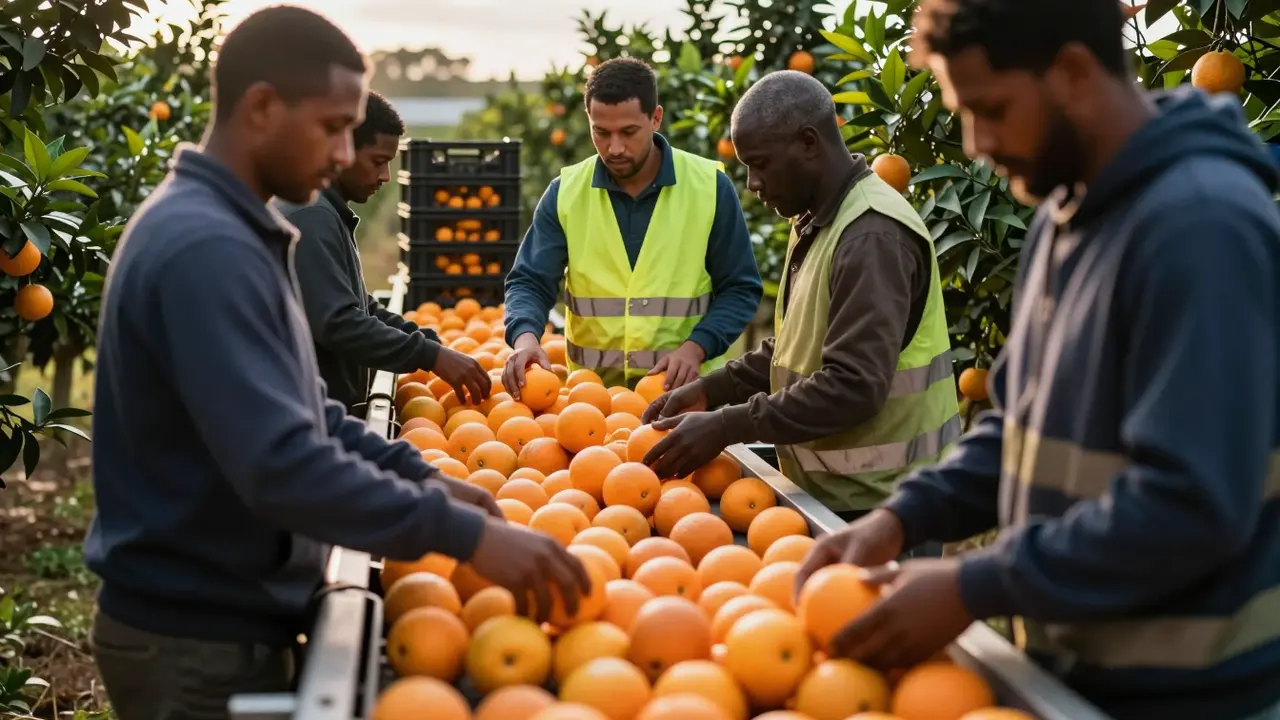
A farm in South Africa is a place where people work, and that can include people who drive tractors, apply chemicals, pick, pack and live nearby. Buyers can ask about worker safety as well as the crop. This page is about the records behind that, and it says plainly where the rules sit outside it. Manage Safety is a record keeping tool, not an adviser.
Does the Occupational Health and Safety Act apply to a farm?
The Act has a general duty on employers. It reads: "Every employer shall provide and maintain, as far as is reasonably practicable, a working environment that is safe and without risk to the health of his employees." The quoted words say every employer. They do not name an industry, and they set no number of employees.
Whether your farm or packhouse counts as an employer under the Act, and what that means for the way you farm, is something a consultant or attorney can confirm for you. This page does not decide it.
Why can export and retail buyers ask about worker safety on a farm?
Because a buyer may ask a supplier about more than the crop. A buyer may ask about worker safety, and this page has no source for what any particular buyer asks for. It differs from buyer to buyer.
What helps whichever buyer asks is being able to put your hand on a document and show its date. Manage Safety never counts a document as current when it cannot be judged, such as one with no document type, or no expiry date on a type that needs one. It is better to find that out yourself than when somebody else asks.
How do seasonal workers change what a farm has to keep?
They add people. A harvest can mean many extra hands for a few weeks, and each of them is a person you may need to account for, with whatever they hold for the job they were given.
Whether a seasonal worker is an employee in the Act's sense is not something this page can say. The words quoted above speak of an employer and its employees, and nothing more. A consultant or attorney can tell you.
What the records can do is simpler. Some of those workers may never log in to anything, and some may have no email address. That is normal. In Manage Safety a person can be recorded with no email address and no way to log in, with their documents filed against them by type and expiry date.
What should a farm hold about tractors, machinery and the people who drive them?
Think in two groups. The machines: whatever certificates and inspection records apply to each one, with their dates. The people: whatever each driver or operator holds for that machine, with the date filed against their name.
Which machines need what, and what the driver needs, depends on what you run and on rules this page does not cover. A consultant can tell you what applies. A record keeper can hold what you have, by type, with its date, and keep every version of a file.
What should a farm hold about chemicals and the people who apply them?
The same two groups apply. What your farm holds about the chemicals themselves, and what the people who apply them hold, each with a date where one applies.
The rules on chemicals are outside this page, and so are the rules on who may apply them. Someone who knows them can tell you which reach your farm. Once you know, the certificates and their dates can be filed against the right person.
Who answers for contract harvesting and spraying teams?
This page cannot tell you. It depends on the facts, on your agreement with the contractor and on how the work is done, and it is a question for an attorney or a health and safety consultant.
What you can do is know who came onto your land and what they were asked to show before they started. Contractor and subcontractor records can be kept by company and by site, and an administrator can load them, so the contractor needs no way to log in. Our page on hiring contractors covers what to ask for from outside parties.
What changes when workers live on the farm?
For records, how you divide the farm is up to you. The packhouse, the homestead and the outlying blocks could each be set up as their own branch or site. In Manage Safety a company can have branches and project sites, each with its own records.
What the law says about people who live on a farm is outside this page, and it is a question for an attorney. Nothing here should be read as saying anything about it.
Which farm records carry dates?
Several groups carry a date that can lapse. Certificates for the people who run machines and apply chemicals. Records for the equipment. Appointment letters for people named to safety roles. The documents your contractors hand over.
Every dated document wants its date on it, in one place. In Manage Safety a document with an expiry date is marked by colour: expired, or expiring today or within the next 60 days. It never disappears because it expired, so the evidence stays on file. Expiry shows by colour on the record, so somebody needs to look. Do not rely on an email before each document expires.
Appointments work in a similar way. A person can be appointed to a safety role at a company, the appointment can be limited to one branch or site and can carry an expiry date, and it is ended when the person leaves the role. An appointment in Manage Safety does not carry a proof document, so the signed letter is filed as a document in the usual way.
How does a packhouse differ from the farm around it?
It may be run as a separate place with its own people, equipment and visitors. Whether the rules differ for it is a question for a consultant, and this page does not say.
For records, it can be set up as its own branch or site, so its documents and appointments are not mixed with the orchards or lands. A history shows who did what and when. If the packhouse also handles food, our page for food and beverage separates food safety from health and safety at work.
Which duties apply to my farm at each time of the season?
That depends on what you grow, what you run, how many people you bring in and when, and what your buyers ask for. No honest page can give one list for every farm, and this one will not try.
A health and safety consultant works out which duties apply to you, and how often each has to be done. Manage Safety then holds those dates, marks anything that lapses within the next 60 days, and puts work that has a due date on a calendar. Book a free walkthrough and bring what you have. If you have no consultant, we can introduce you to one.
How does Manage Safety help a farm or packhouse?
It keeps the worker side of your records in one place. Your people are recorded with their documents, including seasonal people with no email address. Your contractors are held by company and by site with their dates, and a history shows who did what and when. For how training certificates are kept, see our guide to training records. The team behind the platform offers a free walkthrough, setup and data loading, ongoing support and an introduction to a consultant. Read about our services.
The limit is plain. Manage Safety holds records. It does not decide which records your farm needs.
What Manage Safety does and does not do
We do not give legal advice, and we do not make anyone compliant. Manage Safety is a place to keep records and see what is missing or lapsing. It does not tell you what the law requires of your business, and it does not create your documents. Professional answers come from a health and safety consultant, yours or one we introduce.
How do I start as a farm or packhouse?
Book a free walkthrough. We look at your situation with you, and we tell you honestly whether Manage Safety fits.
What the regulation says
8. (1) Every employer shall provide and maintain, as far as is reasonably practicable, a working environment that is safe and without risk to the health of his employees.