
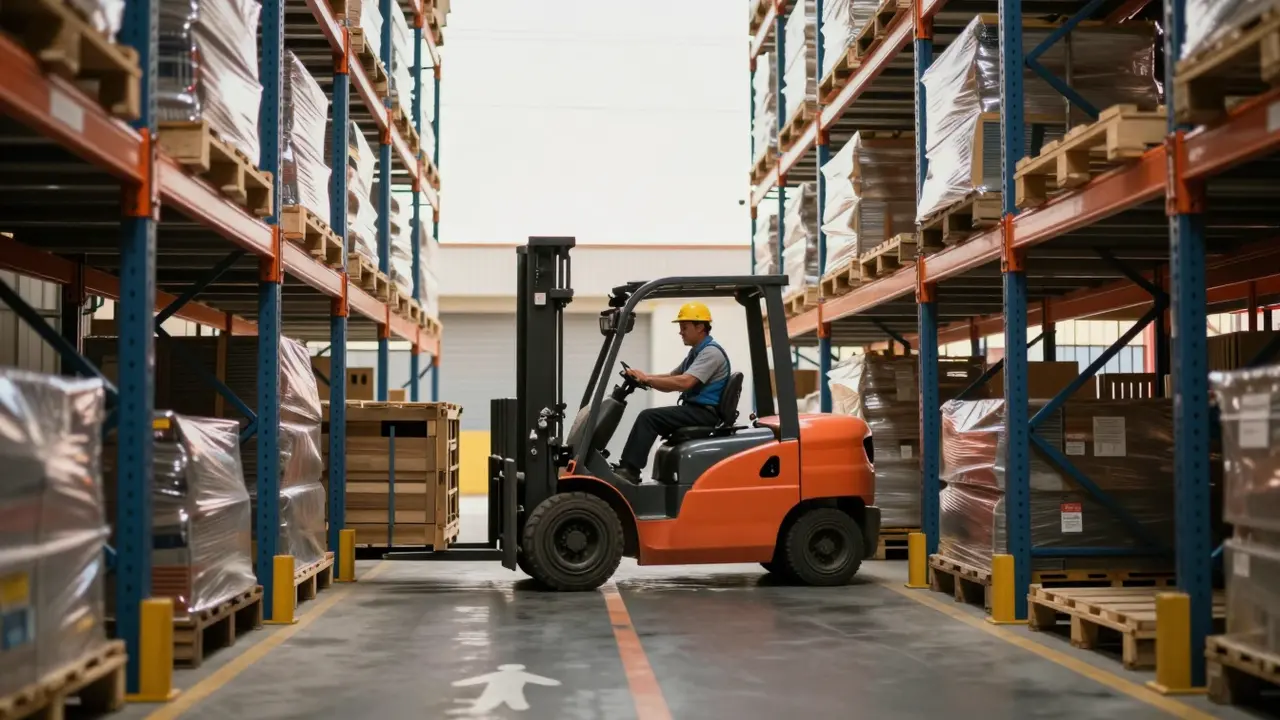
A warehouse in South Africa runs on people and machines at the same time, and the paperwork for each lapses on its own dates. A person's certificate can be fine while the machine they use is overdue, or the other way round. This page is about keeping both sets of dates where somebody can see them, and about the outside crews who pass through your gates. Manage Safety is the place where those records can live.
Which parts of health and safety law reach a warehouse floor?
The Occupational Health and Safety Act puts a duty on the employer. Section 8(1) of the Occupational Health and Safety Act reads: "Every employer shall provide and maintain, as far as is reasonably practicable, a working environment that is safe and without risk to the health of his employees." The quoted words say every employer, and they set no number of employees.
So the duty is not tied to the size of the shed. If you employ people to pick, pack, load and drive, whether you count as an employer under the Act is something a consultant or attorney can confirm for you.
There are other rules as well, including rules for particular machinery. Some are outside what this page covers, and a health and safety consultant can tell you which ones reach your warehouse.
Why do forklifts create two sets of dates to watch?
A forklift brings the machine and the operator into one job, and each has its own paperwork. The machine has whatever certificates and inspection records apply to it. The person has whatever shows they are trained for it. Those two sets do not lapse on the same day, so a warehouse that tracks only one of them is only half watching.
One regulation speaks to the operator side. Regulation 18(11) of the Driven Machinery Regulations, 2015 says: "The user shall ensure that every lifting machine is operated by an operator specifically trained for that particular type of lifting machine". It goes on to deal with lifting machines listed in the National Code of Practice for Training Providers of Lifting Machine Operators. The full text is in the sources at the bottom of this page.
Whether a particular machine in your warehouse is a lifting machine under that regulation, and which of them are on that list, is for a consultant or an attorney to confirm. What a record keeper can do is hold each date as it is: the machine's records filed under the company or site that holds the machine, and the person's records filed against the person, each with its expiry date.
Who answers for outside drivers and their crews inside a warehouse?
Trucks arrive all day. Drivers, loaders, a crew hired for a seasonal peak, an engineer who services the dock levellers. Our page for transport and logistics covers the depot, yard and workshop records of a transport business. They work in your space, around your staff and your machines, and they are not on your payroll.
Section 8(1) speaks of "his employees". Whether and how the Act reaches a visiting driver or a crew from another company is a question for a consultant or an attorney, and this page does not answer it. The practical side is easier to say. You want to be able to show who the outside companies were, what they were asked to hold, and what you actually received. Our guide on hiring contractors covers what to ask for before outside people start.
In Manage Safety, contractor and subcontractor records are kept by company and by site, and an administrator can load them, so the contractor needs no login.
Which warehouse records lapse without anybody noticing?
The quiet ones are the ones nobody owns. Think of three groups: documents on the people who work for you, documents on the machines and the building, and documents handed over by outside companies. Appointments belong in the first group, because a named person can be appointed to a safety role for a limited time.
Which of these your warehouse needs depends on what you store, what equipment you run and how many people you employ. The habit does not depend on any of it. Every dated document wants its date on it, in one place, where somebody can see it before it lapses and not after.
In Manage Safety a document with an expiry date is marked by colour: expired, or expiring, which means today or within the next 60 days. It never disappears because it expired. Manage Safety never counts a document as current when it cannot be judged, such as one with no document type, or no expiry date on a type that needs one. Expiry shows by colour on the record, so somebody needs to look. Do not rely on an email before each document expires.
What should a warehouse hold about racking and lifting equipment?
Think of it as a file for each item that can hurt someone if it fails: the racking, the forklifts and other lifting machines, the dock equipment. For each, the file holds whatever certificates, inspection records and repair notes apply, each with a date.
This page does not quote any rule on racking. Which checks apply to yours, and how often, depends on the system and how it is used, and a consultant can tell you. On the lifting side, the one rule quoted above is about the operator. Once you know what applies, the records for each item can be held by document type with their dates, and every version of a file is kept.
How do labour broker staff change what a warehouse must keep?
Some warehouses lean on temporary workers supplied through a broker, especially in busy months. The people are on your floor and on your machines, but their paperwork may sit with somebody else.
Who is responsible for them under the Act depends on the arrangement, and that is a question for a consultant or an attorney. This page does not give an answer. Records are easier. A person can be recorded with no email address and no login, with their documents filed against them by type and expiry date. Records for outside companies are kept by company and by site, and an administrator can load them. If a temporary worker is going to run a machine, you want their training document on file before the first shift.
What does a customer or landlord ask a warehouse operator to prove?
It differs from one customer to the next, and there is no single list. A customer who stores goods with you, or a landlord who owns the building, may ask to see appointments, training records for the people who run your equipment, documents for your outside contractors, or how incidents are recorded and followed up.
What helps in every case is being able to find the document quickly and to show its date. In Manage Safety an incident or a near miss is logged against the company and moves through three phases: Flash Report, Investigation and Close Out. The Investigation phase is submitted only by an appointed investigator. A history shows who did what and when.
How does a warehouse with several sheds keep its records apart?
A company can have branches and project sites, each with its own records. A site is its own record with its own documents and appointments, and the Sites list shows a count of expired and expiring documents per site. An appointment can be limited to one branch or site and can carry an expiry date.
A site can also be shared with another company for reading, which gives that company read access to that site's documents only. That can suit a customer or landlord who asks to see what you hold for one shed. Read more on multiple sites and branches.
What belongs on a warehouse's calendar?
Anything that has a due date and needs somebody to act. A tender return, a follow up after a near miss, a task to get a missing certificate from a contractor. In Manage Safety tickets and tasks can carry a due date and show on a calendar by month, week or day, beside events people add.
The calendar does not replace the document colours. It is for work somebody has to do. The colours on the documents themselves tell you what has lapsed.
Which examinations and renewals apply to my warehouse, and how often?
That depends on what you store, what equipment you run, how many people you employ and how the building is used, so no honest page can give you one schedule for every warehouse. Some dates come from the certificate itself, some from a regulation, and some from your own risk assessment.
A health and safety consultant works out which apply to you. Manage Safety then holds those dates and marks anything that lapses within the next 60 days. Book a free walkthrough and bring whatever you have. If you have no consultant, we can introduce you to one.
How does Manage Safety help a warehouse or distribution business?
It keeps the records for your people, your outside companies and your sites in one place. Records can be kept for people who never sign in, contractor records are held by company and by site, and a site's count of expired and expiring documents shows on the Sites list. The team behind the platform offers a free walkthrough, setup and data loading, ongoing support, and an introduction to a consultant. Read about our services.
The limit is plain. Manage Safety does not decide which records your warehouse needs, and it does not inspect your racking or your machines.
What Manage Safety does and does not do
We do not give legal advice, and we do not make anyone compliant. Manage Safety is a place to keep records and see what is missing or lapsing. It does not tell you what the law requires of your business, it does not perform audits, and it does not create your documents. A consultancy does that kind of work. Professional answers come from a health and safety consultant, yours or one we introduce.
How do I start as a warehouse operator?
Book a free walkthrough. We look at your situation with you, and we tell you honestly whether Manage Safety fits before you pay anything.
What the regulation says
8. (1) Every employer shall provide and maintain, as far as is reasonably practicable, a working environment that is safe and without risk to the health of his employees.
18. [...] (11) The user shall ensure that every lifting machine is operated by an operator specifically trained for that particular type of lifting machine: provided that in the case of a lifting machine listed in the National Code of Practice for Training Providers of Lifting Machine Operators, the user shall not require or permit any person to operate such a lifting machine unless the operator is in possession of a certificate of training, issued by a training provider accredited by the Transport Seta approved for the purpose by the chief inspector.